Persimmon Flower (Kaki no Hana)

Meaning
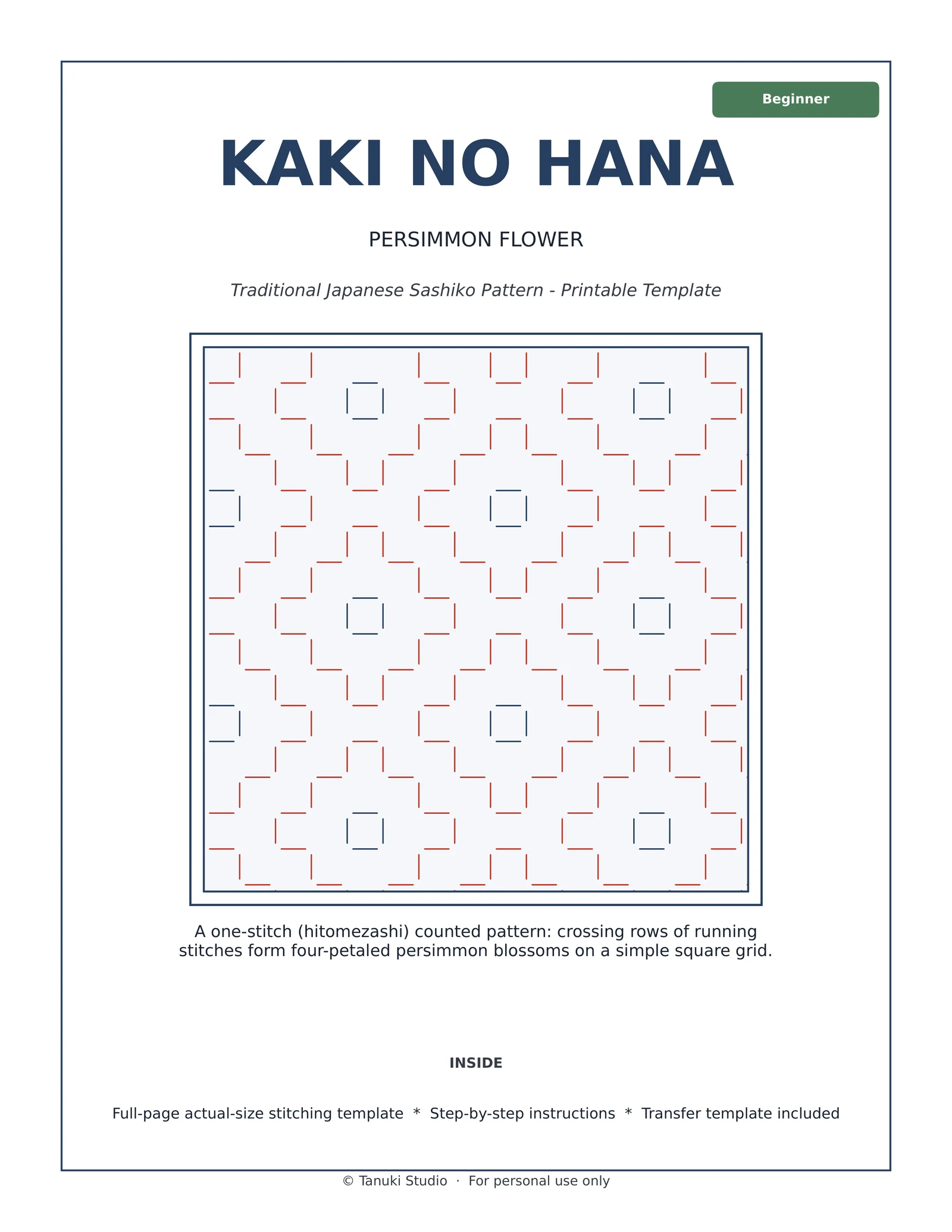
Kaki no hana means simply "persimmon flower." Its small crossing stitches gather into scattered four-petaled blossoms across the cloth, echoing the tiny spring flowers that later become the tree's fruit. Persimmons carry a long-standing place in Japanese culture as a symbol of good fortune and long life, most visibly in dried persimmon offered as a traditional longevity gift, and that warmth carries over naturally to a motif named for the tree's own blossom, even though no source ties that symbolism specifically to this pattern by name.
History
Kaki no hana sits within the hitomezashi tradition of Shonai, a district in Yamagata prefecture, documented firsthand by textile researcher Susan Briscoe during 1991 fieldwork with local sashiko teacher Chie Ikeda. That tradition grew out of household need: early in the Edo period, sumptuary restrictions limited what farming families could wear, and hitomezashi's dense counted grids became a practical way to quilt layers of plain cloth together for warmth.
Most sources describe this blossom motif as traditional within the hitomezashi family, without giving it a separate dated origin.
Stitching notes
Kaki no Hana works differently from most of the other patterns here. Instead of following one continuous line, it is a true hitomezashi design: short, single-length running stitches counted row by row and column by column. Each stitch is exactly one grid unit long.
Work every horizontal row first, then every vertical column, and the four-petaled blossoms appear entirely on their own wherever the two sets of stitches cross, with no extra shaping needed to draw them out.
Hitomezashi uses more thread than a similarly sized continuous-line pattern, because it carries the thread across the back between each short stitch. That density is also part of its strength: the counted grid locks the layers of cloth together, which is one reason hitomezashi has such a long history in visible mending.
Get the full pattern on Payhip
Additional sizes, an extended stitch guide, and a grid-spacing reference sheet.
Buy on Payhip → (opens Payhip in a new tab)Secure checkout via Payhip. Pay by card or PayPal.
Three free patterns, plus 15% off
Jūjizashi, Dan Tsunagi, and Komezashi, with a plain how-to for all three.