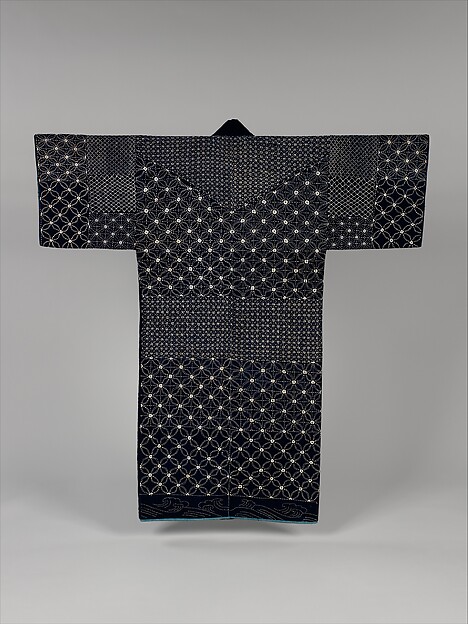
What moyozashi is
Moyozashi means pattern sashiko — the flowing running-stitch style behind most of sashiko’s larger geometric designs. Its lines bend, curve, and cross to draw a motif across the cloth, where its counterpart hitomezashi (one-stitch sashiko) builds a design from single stitches placed square by square on a grid. Both are geometric; moyozashi is the continuous-line look you see in many classic patterns, like the Lightning Spiral (Raimon) and others in the pattern library.
Where it comes from
Moyozashi is the oldest and most widespread face of sashiko — the running-stitch patterns that reinforced and warmed everyday workwear in northern Japan, from farmers’ coats to firefighters’ jackets. For the fuller story — sashiko’s Edo-period origins, the boro mending tradition, and the rules that shaped the craft — see A short history of sashiko.
How it’s worked
Moyozashi is a simple running stitch worked over a marked grid, sized to suit the pattern. The stitches are small — around 3mm (⅛in) long, with a gap of about 1.5mm (1⁄16in) between them — flexing a little so they sit evenly across each repeat.
Where the stitched lines meet, they don’t cross on the front of the work: you leave a tiny gap on the front and let the threads cross on the back instead, and the more lines that converge at a point, the larger that little gap needs to be. Unlike hitomezashi, moyozashi stitches aren’t counted — you simply keep the number of stitches consistent within each section so the rhythm stays even.
Traditionally the work is white thread on indigo cloth, though regions varied (Nanbu sashiko, for instance, is known for light-blue thread). Sashiko thread is a little thicker than ordinary sewing thread — twisted from several finer threads for strength — so it’s usually worked with a needle that has a larger eye.
How it differs from hitomezashi and kogin
Hitomezashi (one-stitch sashiko) is worked on a small grid, often about 6mm (¼in). Straight rows of running stitch travel back and forth — horizontally, vertically, and sometimes diagonally — and the stitches meet or cross to build the pattern, so the finished cloth reads almost like weaving.
Kogin is a related counted-thread tradition from the Tsugaru region of present-day Aomori Prefecture, in the far north. It’s recognized by its white diamond patterns worked on indigo, and it’s often treated as a style of its own.
Common moyozashi motifs
Many of the classic geometric patterns are moyozashi designs, and their names describe what they picture: seigaiha (blue ocean waves), uroko (fish scales), and shippo (the interlocking circles of the “seven treasures”). You’ll find several of these — with the history and stitch order for each — in the pattern library.
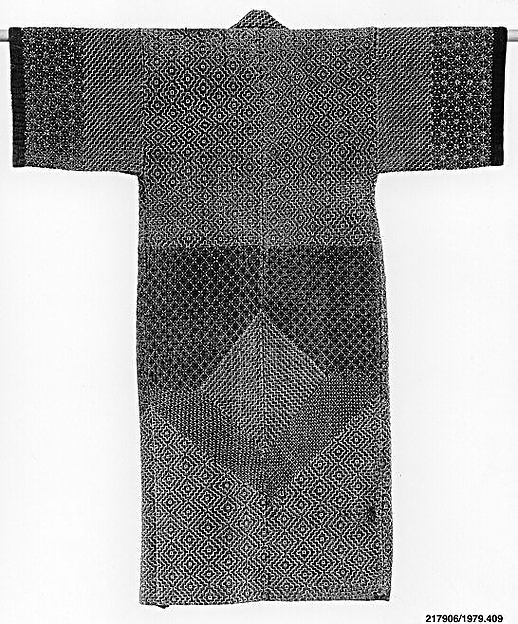
Where you’ll see it, and how to use it
Moyozashi began as a way to reinforce and warm everyday clothing, and to give worn cloth a second life through mending. Today the same running-stitch patterns are stitched for their own beauty — on garments, patched and mended pieces, and home textiles — anywhere the quiet rhythm of the stitch feels at home.