What hitomezashi is
Hitomezashi means one-stitch sashiko, and the name describes how it’s built: from single running stitches placed one grid-space at a time. Worked across a grid, those small stitches line up in rows that meet and cross, and the repeats build into dense geometric patterns — often looking a little like woven cloth, or European blackwork. It’s the quieter, grid-based counterpart to moyozashi, whose flowing lines draw larger motifs.
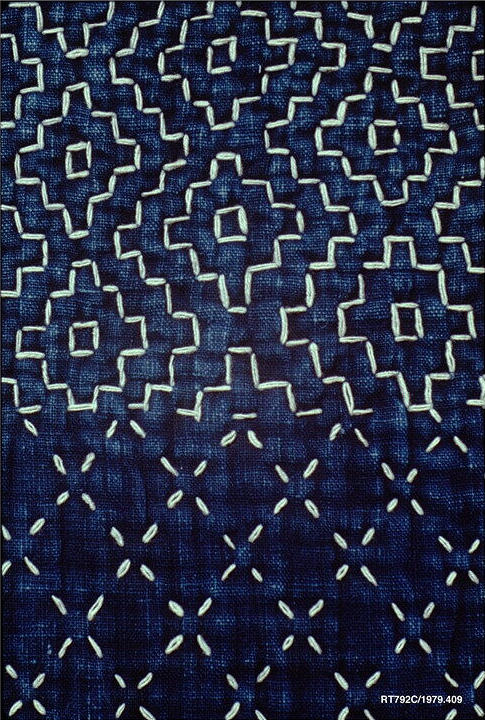
Where it comes from
Hitomezashi is especially associated with Yamagata, in the north, where working families stitched it to patch, mend, and reinforce everyday garments. Like all sashiko, it made the most of scarce cloth and worked within the sumptuary rules of the day — small stitches, no larger than a grain of rice, in light thread on dark indigo. For sashiko’s broader Edo-period story, see A short history of sashiko.
How it’s worked
You begin by drawing a grid on the fabric, traditionally around 6mm (¼in). Following the pattern, you make one running stitch per grid space — stitching some sides of each square and skipping others — using only the simple running stitch. Because the grid sets the stitch length, the stitches stay small and even, and they’re the same length on the front and the back; the reverse often carries a pattern of its own. Rows travel back and forth — horizontally, vertically, and sometimes diagonally — and where they meet or cross, the design appears, denser than moyozashi’s open lines.
A related technique, kugurizashi, weaves a second thread through a finished hitomezashi grid — see that article for the full picture.
How it differs from moyozashi and kogin
Moyozashi draws longer, curving lines of running stitch to form larger motifs; hitomezashi instead builds its pattern from single stitches on a square grid, giving a denser, weave-like surface. Kogin is a different tradition again — a counted-thread style from the far north, known for white diamonds on indigo.
Where you’ll see it, and how to use it
Hitomezashi began as a way to strengthen and extend the life of everyday clothing. Today its grid-built patterns are stitched for their own quiet beauty — on garments, mended pieces, and home textiles. You’ll find patterns to try in the pattern library.