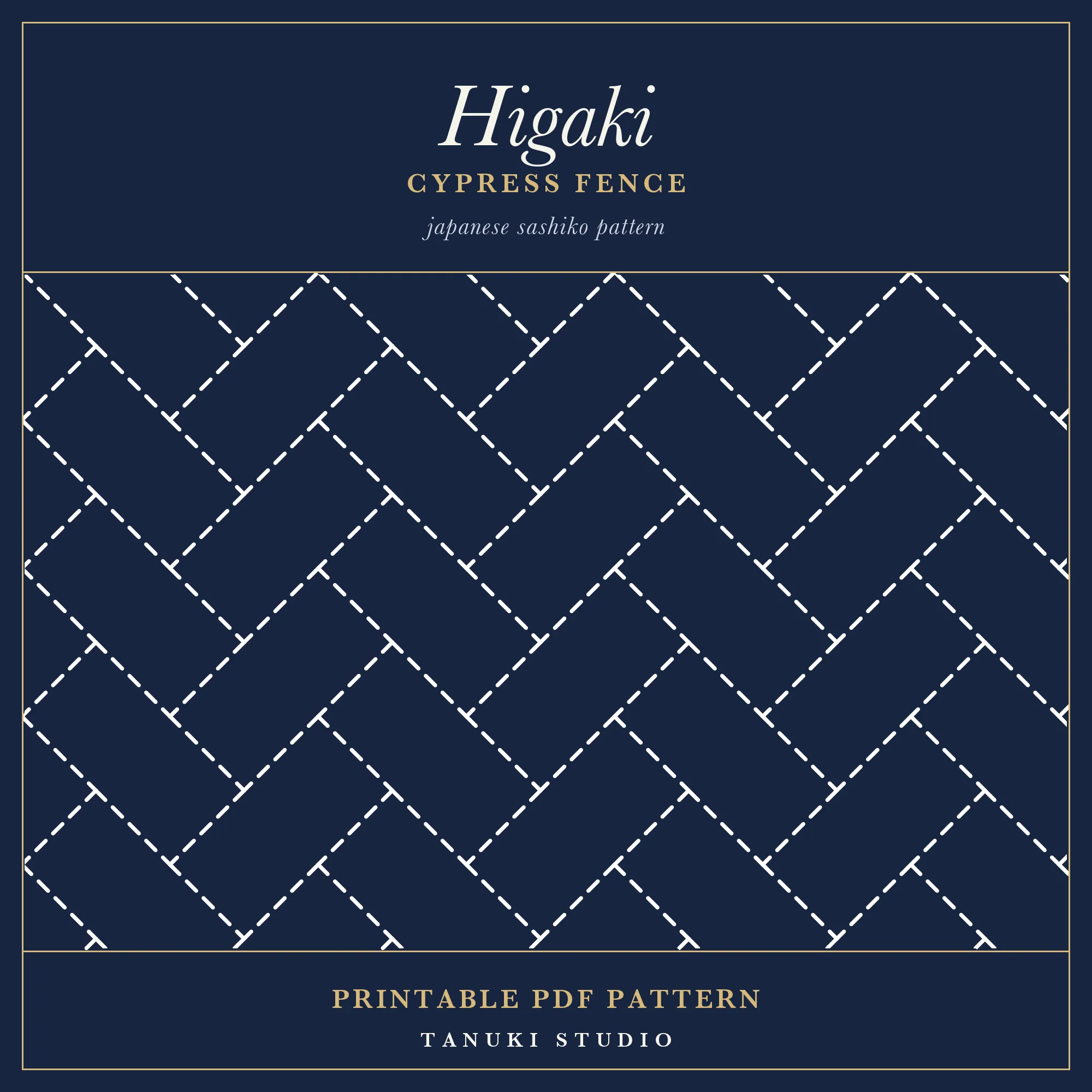
Cypress Fence (Higaki)
Meaning
Higaki names a real piece of architecture before it names a stitch: a fence woven from thin strips of hinoki, Japanese cypress, set on the diagonal so each plank crosses over and under its neighbors. That diagonal weave has a long life in Japanese building, still visible in garden fences, ceiling panels, and screens.
As a pattern, Higaki is usually read through structure and material: the diamond spaces where the planks cross, the durability of cypress, and the fence's quiet sense of protection.
History
The weaving technique is older than its textile use. It entered kimono and obi design during the Edo period, part of a wider habit of turning everyday woven objects, fences, baskets, mats, and screens, into cloth patterns.
Higaki and Ajiro are closely related names in Japanese pattern sources. Here they are charted separately: Higaki as a diagonal herringbone of planks, Ajiro as a checkerboard of over-under ribbons.
Stitching notes
Higaki is built from single planks, each one twice as long as it is wide, laid at a 45-degree angle in a true herringbone. Every plank crosses under one neighbor and over the next, the same logic as the woven fence it is named for.
The stitching works in two passes, one direction of planks at a time. Carry the thread loosely across the back wherever a line ducks under a crossing plank.
Comfortably within reach for a first sashiko project: every plank is a short, straight running-stitch line, so there’s no tricky pivoting or centered motif to track, just steady diagonal rows worked one direction, then the other, until the woven look appears entirely on its own.
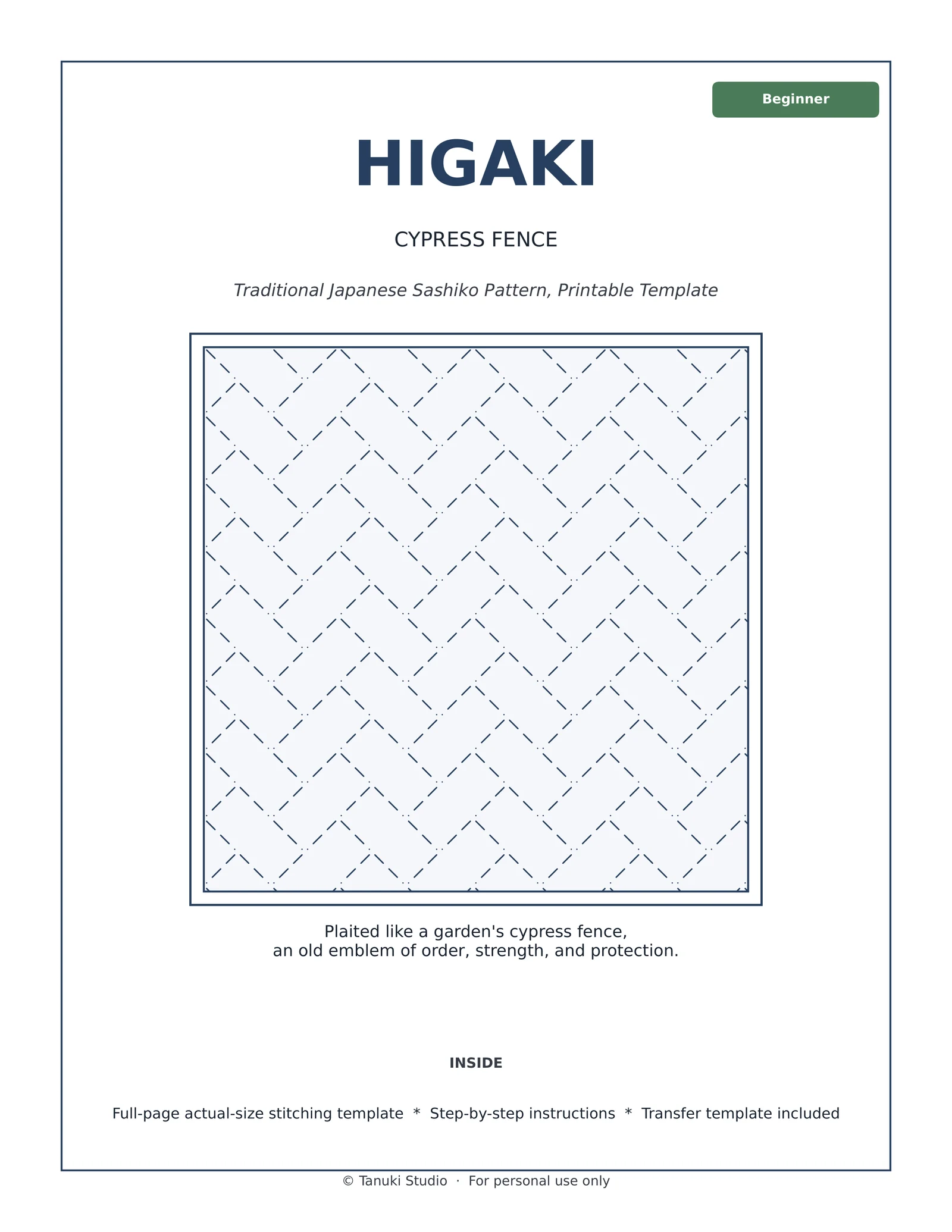
Get the full pattern on Payhip
Additional sizes, an extended stitch guide, and a grid-spacing reference sheet.
Buy on Payhip → (opens Payhip in a new tab)Secure checkout via Payhip. Pay by card or PayPal.
Three free patterns, plus 15% off
Jūjizashi, Dan Tsunagi, and Komezashi, with a plain how-to for all three.