Flowing Current (Nagare Manji)
Meaning
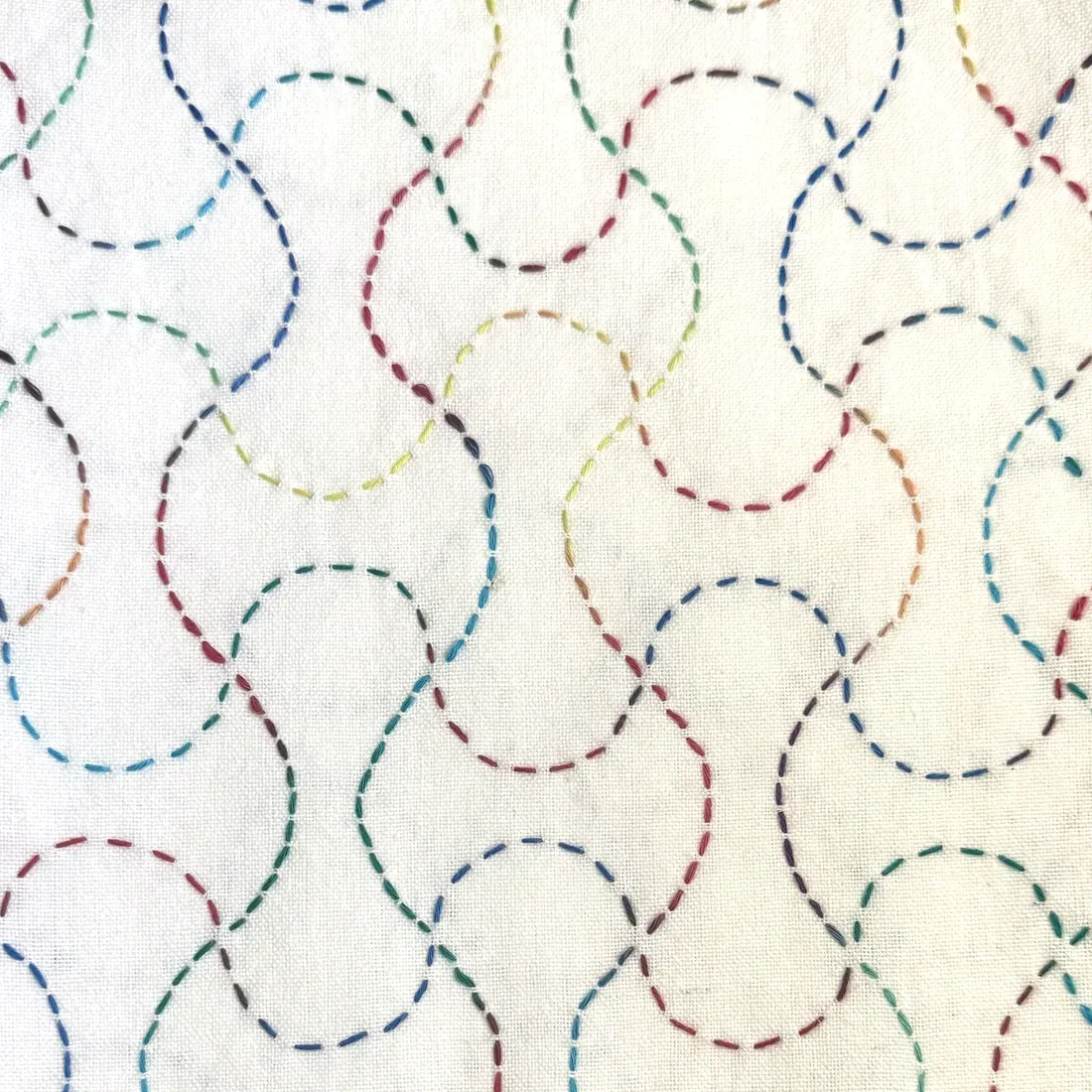
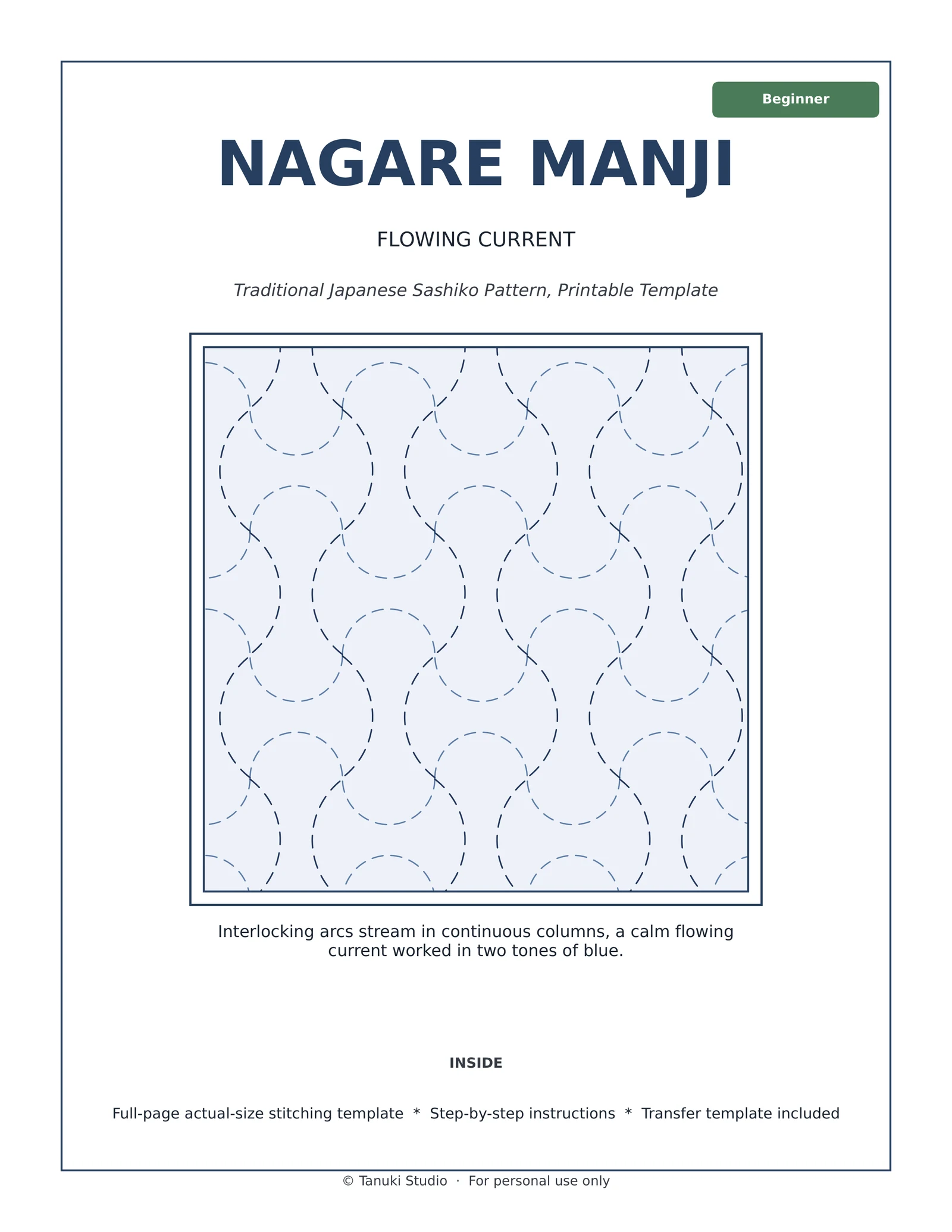
Nagare means "flowing current," describing how the interlocking arcs stream down the cloth in continuous columns. The pattern belongs to the tsunagi ("connected") family of sashiko motifs, unbroken repeating lines like jūji-tsunagi and shippō-tsunagi that have long carried associations of continuity, flow, and lasting good fortune. Its full name also nods to manji, the ancient Buddhist symbol of virtue and auspiciousness whose linked, unbroken form (as in manji-tsunagi and sayagata) came to represent longevity and family prosperity precisely because it repeats without interruption. Here, that same idea of endless, unbroken flow is carried by a curve rather than the manji's traditional right angle.
History
The manji symbol arrived in Japan alongside Buddhism, where it marked virtue and auspiciousness in Buddhist art. Its continuous, chained form (known by names including manji-tsunagi, manji-kuzushi, and sayagata) reached Japan from Ming-dynasty China during the Momoyama period (16th century) and became a staple woven ground pattern on kimono silk. Because the linked shape repeats edge to edge with no visible start or end, it was read as a wish for longevity and unbroken family prosperity across generations, a meaning it shares with the wider tsunagi family of connected sashiko motifs.
Nagare Manji is classified as moyozashi, a pattern-drawn style suited to flowing, all-over repeats. Its name places it in the manji-descended lineage, but the stitched geometry is different from the traditional right-angled meander. This chart carries the idea of unbroken flow through continuous interlocking curves.
Stitching notes
Nagare Manji might be the most relaxing pattern in the collection to stitch. There is no grid to count and no corner to square. Two families of arcs, wide flowing columns and smaller connecting arcs, cross and link in a steady rhythm across the cloth.
Work the columns first, one continuous curved line moving top to bottom. Then come back with the connecting arcs left to right. Because the curves are broad and even, small variations in stitch length blend into the line instead of standing out the way they would on a straight edge or sharp turn.
The two-tone palette also helps while you stitch: deeper blue for the columns, lighter blue for the connecting arcs. The finished piece has a soft current to it, with the paler lines seeming to move over the darker ones.
Ways to use it
An all-over field for home textiles
The pattern's steady, unbroken rhythm reads best filling a broad surface. Worked edge to edge across a cushion front or a table runner, the interlocking curves read like a current rippling steadily across the cloth.
A first sashiko sampler
With no grid to count and no sharp corners to square, Nagare Manji makes a gentle first project for anyone new to continuous-line sashiko, building comfort with the running stitch before moving on to angular, grid-based patterns.
Visible mending on soft edges
A small patch of Nagare Manji stitched over a worn cuff, hem, or knee turns a repair into a calm, deliberate detail, well suited to rounded mends where a sharp-cornered pattern would sit at odds with the garment's curve.
A tote or pouch panel
Worked across the front of a tote bag or the flap of a simple pouch, the flowing pattern adds quiet movement without needing a busy print to carry it.
For this pattern: Because the design leans on the contrast between its two blues to read clearly, choosing two threads with a real value difference (rather than a tone-on-tone pairing) keeps the flowing columns and connecting arcs visually distinct instead of blurring together.
Get the full pattern on Payhip
Additional sizes, an extended stitch guide, and a grid-spacing reference sheet.
Buy on Payhip → (opens Payhip in a new tab)Secure checkout via Payhip. Pay by card or PayPal.
Three free patterns, plus 15% off
Jūjizashi, Dan Tsunagi, and Komezashi, with a plain how-to for all three.