What kugurizashi is
Kugurizashi (“kuguri,” to go through or under, plus “sashi,” stitch) is something you add on top of a finished hitomezashi grid — the one-stitch, square-grid style of sashiko. It isn’t a fourth style to learn alongside hitomezashi, moyozashi, and kogin; think of it as a second stage for a grid you’ve already stitched. Once the grid is done, a second thread gets woven under the existing stitches instead of sewn into the fabric — many stitchers pick a contrasting color for that second thread, though it’s not required.
Where it comes from
Where hitomezashi and kogin trace to specific Edo-period regions, kugurizashi’s story is much newer: a Japanese thread maker teaches the technique today, and a craft blogger has written about learning it from one of that maker’s product releases. So instead of its own centuries-old hometown, kugurizashi’s history really is the history of the hitomezashi grid it gets stitched onto — and that one does trace back to Yamagata, in Japan’s north. For that fuller story, see A short history of sashiko.
How it’s worked
The base grid is stitched as it is in hitomezashi: single running stitches, one grid-space at a time, in rows traveling back and forth until the grid pattern is complete. Then the second thread is woven under those stitches. In this stage, the needle passes under the existing stitches; some stitchers work eye-first to avoid splitting the base stitches. Because that second thread lies across the top instead of piercing through, kugurizashi ends up with a richer texture than a plain hitomezashi grid on its own.
How it differs from hitomezashi, moyozashi, and kogin
Kugurizashi can resemble a doubled hitomezashi grid at first glance: two separate running-stitch passes worked over the same grid, each piercing the cloth on its own, can produce a similar two-color, two-layer look. But kugurizashi’s second thread is woven through without ever piercing the cloth.
Moyozashi is its own thing entirely: its flowing, curving lines of running stitch draw a single continuous motif, with no base-and-second-layer structure at all. Kogin is different again — it’s a counted-thread tradition, so its diamond patterns come from counting threads in the weave itself, not from stitching a second pass onto a hitomezashi grid.
Where you’ll see it
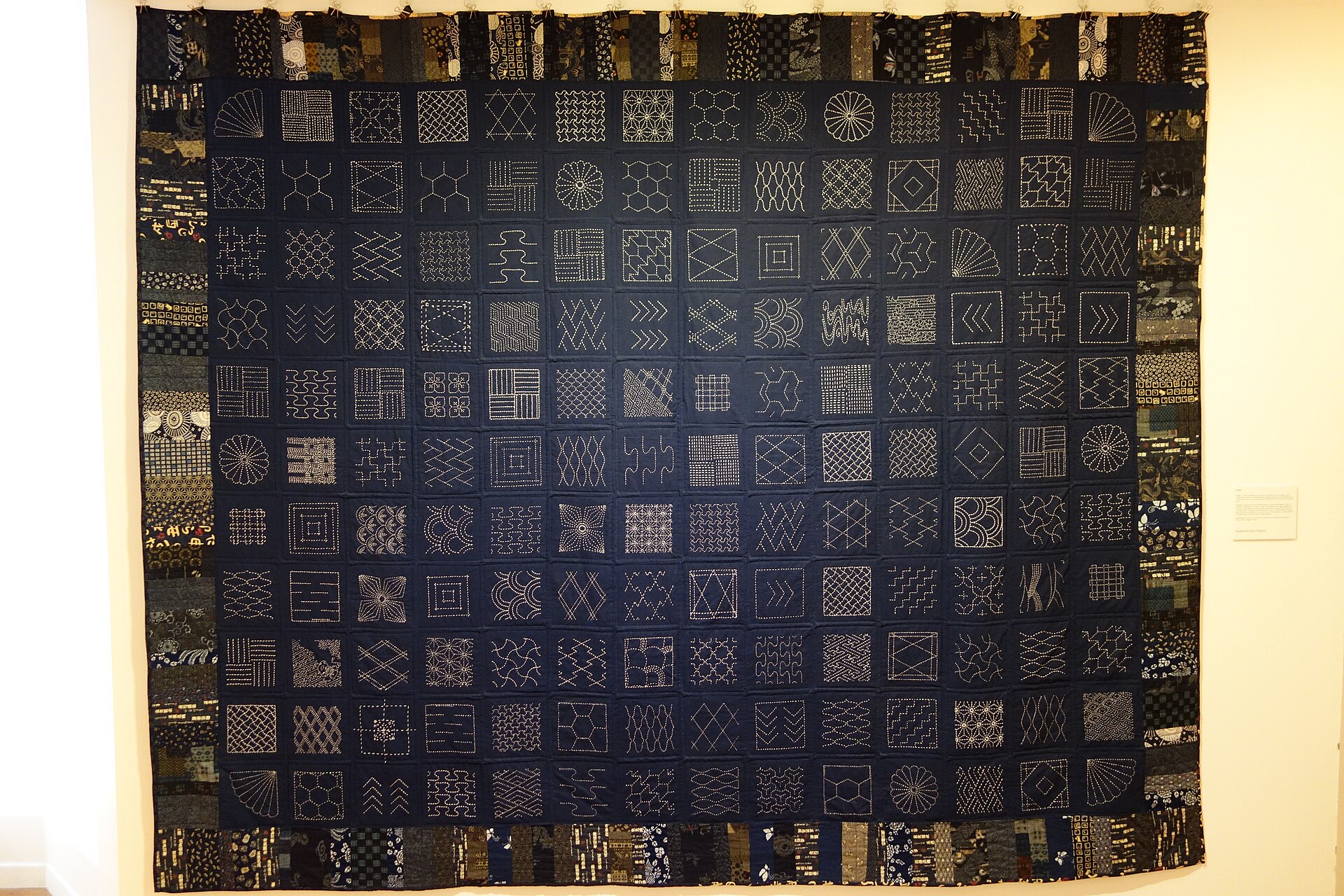
Kugurizashi is a small-scale technique, and it tends to show up on small-scale pieces. Hanafukin — the same pocket-sized sampler cloths behind this site’s own hanafukin project — are a common place to find it, since one square is enough room to show off the two-layer look without a long project. The size of the base grid changes how it reads, too: a bigger grid gives bold, graphic diamonds, while a tighter grid reads more like a subtle plaid. Try it yourself: stitch any hitomezashi grid from the pattern library, then weave a contrasting thread through it — that’s kugurizashi.